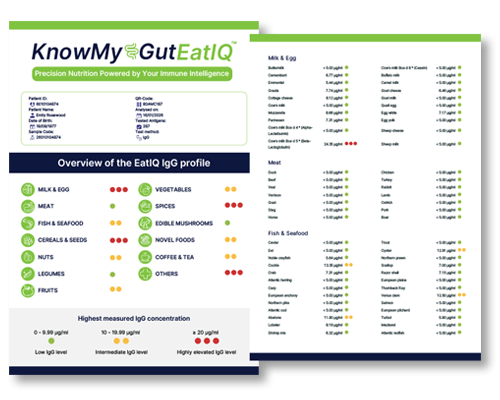
An advanced IgG blood test that reveals how your immune system responds to the foods you eat every day - identifying delayed food reactions that standard allergy tests are designed to miss.
Powered by Independente Research

EatIQ is an advanced IgG (Immunoglobulin G) food reaction test - a blood-based analysis that measures how your immune system responds to 283 different food antigens. Unlike standard IgE allergy tests that detect immediate reactions, EatIQ identifies delayed food reactions that can take between 4 and 72 hours to produce symptoms - making them almost impossible to identify without testing.
When the gut lining is compromised - a condition known as increased intestinal permeability or "leaky gut" - food particles cross into the bloodstream and trigger an IgG-mediated immune response. These reactions are not true allergies, but they generate a low-grade, chronic immune activation that can influence digestion, energy, inflammation, mood, skin health, and overall wellbeing in ways that are easy to overlook and difficult to trace back to specific foods.
EatIQ is included in the Kids BioCare platform as part of our integrated approach to maternal and child health - analysing how a mother's immune system responds to the foods she eats during pregnancy, breastfeeding, and postnatal recovery.
There are two distinct types of immune food response. Standard allergy testing detects IgE reactions - which are immediate, dramatic, and relatively easy to identify. EatIQ detects IgG reactions - which are delayed, subtle, and the source of most unexplained food-related symptoms.
IgE antibodies trigger rapid, dramatic immune responses - typically within minutes. These are classic allergies: hives, swelling, anaphylaxis, and respiratory distress.
IgG antibodies produce slow, cumulative immune responses that can take 4-72 hours to produce symptoms. These are the reactions most people are living with without knowing the cause.
When intestinal permeability increases - often due to dietary stress, antibiotic exposure, infections, or inflammation - food proteins cross the gut wall and enter the bloodstream. The immune system produces IgG antibodies against these food particles. These antibodies form circulating immune complexes that can adhere to vessel walls, trigger systemic inflammation, and drive the persistent, hard-to-explain symptoms that affect millions of people. IgG antibodies have a circulating half-life of 21-24 days, meaning the test reflects food exposure patterns over the previous three months - providing a meaningful picture of cumulative immune response to the foods you regularly eat.
IgG food reactions can manifest as a wide range of chronic, low-grade symptoms across different body systems. Because the delay between eating and symptoms can be up to 72 hours, identifying the trigger food without testing is almost impossible.
EatIQ analyses IgG antibody responses to 283 food antigens across all major food groups - providing one of the most comprehensive food reaction panels available. Every food is tested using validated ELISA methodology on a blood sample collected at home or via a nurse visit.
Wheat, gluten, rye, barley, oats, spelt, corn, rice, millet, buckwheat, quinoa and more
28Cow's milk, casein, whey, cheese varieties, goat milk, sheep milk, eggs (white & yolk)
22Beef, pork, chicken, lamb, tuna, salmon, cod, shrimp, crab, oysters, and other seafood
32Tomato, potato, broccoli, celery, garlic, onion, spinach, carrot, mushrooms, and more
48Apple, banana, citrus fruits, berries, mango, pineapple, grapes, avocado, kiwi, and more
38Peanut, almond, walnut, cashew, sesame, sunflower, pumpkin, flaxseed, pine nuts
18Soy, lentils, chickpeas, kidney beans, peas, black beans, lima beans, mung beans
16Coffee, tea, chocolate, yeast, candida, food additives, herbs, and spice antigens
81Browse the complete list of 283 food antigens included in the EatIQ IgG food reaction panel.
EatIQ uses validated ELISA (Enzyme-Linked Immunosorbent Assay) methodology - the gold-standard laboratory technique for detecting and quantifying specific IgG antibodies to food antigens.
A small blood sample is collected at home via a simple finger-prick lancet included in your kit, or through an optional nurse visit for a venous draw. The collection takes under 5 minutes.
Your blood sample is analysed using the ELISA technique in an ISO 15189-accredited laboratory. Specific IgG antibodies are detected and quantified against each of the 283 food antigens, producing a precise numerical result for every food.
Each food receives a quantitative IgG antibody level - not simply "reactive" or "non-reactive." This numerical score is then categorised into three tiers: Green (low / normal), Amber (moderate / elevated), and Red (high / significantly elevated).
Your full colour-coded EatIQ report is delivered through BioHealthcare Hub. A specialist doctor or nutrition consultant reviews your results in a dedicated consultation - explaining what your reactive foods are, why they matter, and exactly what to do.
Every one of the 283 foods tested is presented in a clear colour-coded format - making it immediately clear which foods your immune system is responding to, and at what level.
Your immune system shows a normal, low-level IgG response to this food. These foods are considered safe to eat as part of your regular diet and are unlikely to be contributing to symptoms.
Normal rangeYour immune system is showing an intermediate IgG response to this food. These foods may be worth rotating or reducing - and are likely contributing to symptoms if consumed frequently or in large quantities.
Elevated - monitor & rotateYour immune system is showing a significantly elevated IgG response to this food. Red-rated foods are most likely to be driving immune activation, inflammation, and the symptoms you are experiencing - and are the priority for elimination.
Highly elevated - eliminateThe insights provided by EatIQ go far beyond a simple food list. The combination of 283-food coverage, quantitative IgG measurement, and expert consultation creates a genuinely actionable picture of how your immune system interacts with the food you eat every day.
Many food reactions cause symptoms hours or days after eating - making them impossible to trace without testing. EatIQ reveals the specific foods generating delayed immune responses, even when the connection to symptoms is completely hidden.
4-72 hrsTypical IgG reaction delay windowUnlike simple pass/fail food tests, EatIQ produces a precise numerical IgG antibody level for every food. This allows genuine prioritisation - knowing not just which foods are reactive, but how reactive each one is - so you can focus on the foods that matter most.
283Individual numerical scores per testThe EatIQ report provides a personalised food plan - showing exactly which foods to eliminate, which to reduce, and which to rotate - based on your specific IgG levels. No generic advice; every recommendation is based on your immune data.
IndividualFood plan based on your specific IgG profileResearch in IBS, migraine, and eczema shows that elimination diets guided by IgG testing produce significantly faster and more complete symptom resolution than trial-and-error elimination. You don't need to spend months guessing - the test tells you where to start.
66%Migraine patients symptom-free on IgG-guided elimination dietA mother's food reactions during pregnancy and breastfeeding directly influence the baby's exposure. Inflammatory reactions to foods consumed during pregnancy can affect foetal development, and reactive foods in a breastfeeding mother's diet have been linked to infant colic, eczema, and digestive distress in newborns.
DirectMaternal food reactions transfer to baby via breast milkIgG levels change as the gut heals and the diet changes. Repeat testing - typically after 3-6 months of the elimination and rotation protocol - shows measurably which foods have been successfully tolerated and whether new reactions have developed. Your food map evolves with your gut.
21-24 daysIgG half-life - reflects 3 months of food exposureMultiple elevated IgG reactions across many food categories can indicate increased intestinal permeability - where a compromised gut lining is allowing food proteins to cross into the bloodstream. This is a clinically significant finding that changes the approach to treatment, and is not detectable by standard allergy testing.
Leaky GutMultiple elevations indicate intestinal permeabilityEvery EatIQ report includes a consultation with a specialist doctor or certified nutrition consultant who reviews your results in full - explaining what your reactive foods are, why they matter, what symptoms they're likely causing, and exactly how to structure your elimination and reintroduction protocol.
IncludedSpecialist consultation with every reportYour EatIQ results are delivered through BioHealthcare Hub - the Kids BioCare results dashboard. All results are colour-coded, clearly explained, downloadable, and integrated with your NGS gut test results when both are taken together, providing a complete biological picture of food, gut, and immunity.
HubIntegrated with NGS results in one dashboardNot all food tests measure the same thing. The type of antibody being measured, the number of foods tested, and the methodology used determines what the test can and cannot tell you. Here is a direct comparison.
| Feature | EatIQ IgG TestKids BioCare | Standard IgE Allergy Test |
Skin Prick Allergy Test |
Elimination Diet Only |
Hair / Bioresonance "Intolerance" Test |
|---|---|---|---|---|---|
| Number of foods tested | 283 | 20-100 | 20-50 | None - trial & error | 50-500 |
| Antibody / mechanism tested | IgG (delayed immune response) | IgE (immediate allergy) | IgE (immediate allergy) | None | No validated mechanism |
| Detects delayed reactions (4-72 hrs) | ✓ | ✗ | ✗ | Indirectly | ✗ |
| Detects immediate reactions (IgE) | ✗ (separate test) | ✓ | ✓ | Sometimes | ✗ |
| Quantitative antibody levels | ✓ | ✓ | ✗ | ✗ | ✗ |
| Colour-coded reaction levels | ✓ Green / Amber / Red | Some labs | ✗ | ✗ | Varies |
| Scientific / clinical validation | ✓ ELISA - peer-reviewed | ✓ | ✓ | ✓ | ✗ No clinical evidence |
| Identifies gut permeability signals | ✓ | ✗ | ✗ | ✗ | ✗ |
| Suitable during pregnancy | ✓ | ✓ | Limited | ✓ | ✗ Not validated |
| At-home sample collection | ✓ Finger-prick or nurse | Some | ✗ Clinic only | ✓ | ✓ |
| Speed of results | 2-3 weeks | 1-2 weeks | Immediate | 4-12 weeks | Days |
| Doctor consultation included | ✓ | Sometimes | ✓ | ✗ | ✗ |
| Integrated with NGS gut test | ✓ BioHealthcare Hub | ✗ | ✗ | ✗ | ✗ |
| Personalised food plan provided | ✓ | Some | Some | DIY | ✗ |
| ELISA methodology (gold standard) | ✓ | ✓ | ✗ | ✗ | ✗ Pseudoscience |
| ✓ = Full capability · Partial = Limited or conditional capability · ✗ = Not supported · ELISA = Enzyme-Linked Immunosorbent Assay · IgG = Immunoglobulin G · IgE = Immunoglobulin E | |||||
A precise, quantitative IgG antibody profile across 283 foods - identifying the specific delayed immune reactions driving your symptoms, with a personalised colour-coded food plan, gut permeability insights, and a specialist doctor consultation. Validated ELISA methodology. Integrated with NGS gut testing through BioHealthcare Hub.
Hair intolerance tests and bioresonance devices have no scientific validation. No peer-reviewed research supports their ability to detect food reactions. The mechanisms they claim to use - electromagnetism, quantum resonance - have no relationship to how the immune system processes food. These tests should not be confused with clinically validated IgG blood testing.
When EatIQ and NGS gut microbiome sequencing are taken together, they create one of the most comprehensive gut-immune-food assessments available anywhere - connecting microbiome imbalance with immune food responses in a single integrated report.
EatIQ tells you which foods your immune system is reacting to. NGS tells you what is happening inside your gut microbiome. Together, they reveal the connection - showing how gut dysbiosis is driving increased intestinal permeability, which in turn is triggering IgG food reactions, which are then feeding back into further microbiome disruption.
This combined picture is ideal for mothers with persistent digestive symptoms, families dealing with infant colic or baby eczema linked to maternal diet, and anyone who has tried dietary changes without getting clear answers.
EatIQ analyses 283 food antigens with validated IgG testing - giving you the clearest possible picture of the food reactions shaping your health and your baby's wellbeing.